Septic ~ Water well ~ Pools ~ Sprinklers ~ Termites ~ Sewer Scope ~ Commercial
Certified Septic System Inspections
If you're buying a house with an on-site wastewater (septic) treatment system, have it professionally inspected. Our inspectors are certified through the National Association of Wastewater Technicians (NAWT), an achievement that few inspectors in our area have obtained. NAWT inspectors adhere to a professional code of ethics found here. Septic systems require regular maintenance and can be costly to repair if poorly maintained. Order a certified septic inspection with your home inspection for more savings.

Diagram of a conventional septic system showing wastewater flow and treatment.
Preparing for a Septic Inspection

IMPORTANT!!!
Septic tank lids should be located, visible at the surface, and readily accessible prior to the inspection. Because lids are sometimes buried below the surface, it is the home owner's responsibility to locate and dig up the lids so the system is ready for inspection.
What We Inspect
1.) Layout/Location Requirements
LAYOUT and LOCATION
The Texas Commission on Environmental Quality (TCEQ) regulates private domestic water well installations as well as the installation of on-site sewage facilities (i.e., "septic systems"). We look to make sure the following setbacks are met:
- The septic tank should be at least 50 ft from a water well and the septic leaching (drain) field should be at least 100 ft from a water well, unless the water well was completed per 16 TAC 76.100 (b) 1, in which case 50ft from leaching (drain) field is acceptable. NOTE: Because water well casings are below ground and home inspectors do not typically have drilling reports in hand during a septic inspection, we do not know whether a water well that is between 50 and 100 ft from a drain field is a water well that met this exception. To err on the side of caution in such cases, we will typically report as deficient a water well less than 100 ft from a drain field and recommend a drilling report be obtained to determine if the water well was completed such that it meets the 50ft setback exception.
- The septic system should be 50 ft (tank) or 75 ft (drain field) from streams, ponds, lakes, rivers, creeks, retention ponds/basins
- The septic system should be 5 ft from foundations, buildings, surface improvements, property lines, swimming pools, and other structures
- TCEQ Setback Code Requirements can be found here. See especially pages 114-117.
RISERS and LIDS
- Risers should be visible and accessible and should not require any excavating. This has been in the code for a few years now. We do not excavate to locate or expose the lids because doing so would correct the deficiency of NOT having the lids visible at the surface, as required. We are not there to correct deficiencies but to identify them.
- Access lids should be 20" diameter. The older concrete plugs that are 8-12 inches are no longer allowed.
- Access lids on the tank itself should be water tight and not allow surface water or dirt to enter the tank. Plastic tanks are especially vulnerable to poor lid seals as the tank openings warp and lids no longer provide a water tight fit.

2.) Tank and Contents
HOW IT WORKS
Next we will inspect the inside of any accessible tanks. Typically, there is an "inlet chamber", coming from the house or building, where the first stage of separation takes place. Lighter contents float to the top, known as the "scum layer." Heavier contents float to the bottom, known as the "sludge layer." The middle section is called "effluent." Effluent then passes through a baffle to the outlet chamber, where the second stage of separation takes place. The scum layer is usually much smaller in the outlet chamber. However, the sludge layer can often be as thick or thicker than it was in the inlet chamber. The middle layer that forms in the outlet chamber as the layers separate is called the clear layer or clear effluent. The clear effluent is what flows through the outlet baffle towards the leaching field or drain field and leaches into the soil absorption area.
Concrete tanks for a typical dual chamber system
TANKS
Using a pole camera, we take photos and/or video of the insides of the tank. Here are some of the things we're looking for:
- Roots in a tank can indicate a crack somewhere or a poor lid seal
- Deterioration on concrete tanks can be an early sign of breakdown and eventual failure. Heavy deterioration to the back wall of the outlet chamber around the outlet baffle is often caused by H2S gas in the tank deteriorating the concrete. This back wall eventually becomes brittle and subject to failure. Sometimes it can be repaired but often the tank has to be replaced. Tank replacement can cost several thousand dollars
- Baffles can break or be missing entirely, which negatively affects the system.
- Plastic tank openings can be caved in and channeling dirt or surface water into the tank, which reduces tank capacity, especially at the bottom where a healthy sludge layer should be forming without interference from dirt or gravel.
CONTENTS
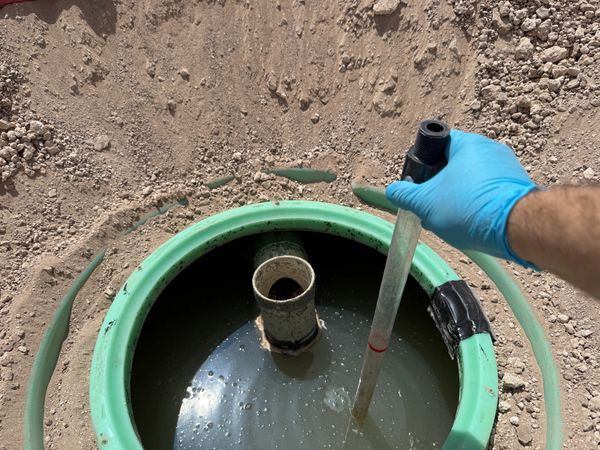
We take measurements of the 3 layers in each of the tanks whenever possible. This helps us determine if the system is performing as intended and if it needs to be pumped out. Here are some of the indicators we are looking for:
- Functional static level should be 2-3" inches below horizontal inlet pipe and at the bottom of the horizontal outlet pipe
- Scum layer should never be above either of the tops of baffles. Sewage contents (like solids or paper) on the tops of the baffles can be an indication of the tank flooding or previous failure.
- The lack of a scum layer on a system that hasn't been pumped but is in regular use can indicate openings to the atmosphere that interfere with the anaerobic process needed for the system to function properly.
AEROBIC SYSTEMS
While the vast majority of septic systems in West Texas are anaerobic/conventional systems, we do sometimes see aerobic systems. These will have a "trash tank", a treatment tank, and a pump tank. They will have a chlorinator as well. Here's what we're looking for on aerobic systems:
- "Trash tank" levels are are measured with a septic checker.
- The treatment tank has an aerator (controlled by a compressor) and should have bubbles. The content should be brownish in color.
- The pump tank has two floats, one at the bottom is triggered when level rises and turns on the pump to send the effluent to the ground; the other float is a high limit and sets off an alarm when the level is too high. Both should manually raised and tested for proper function.
- Sprinkler heads and spray patterns should be inspected for functionality and required setbacks.
- All electrical connections should be water tight.
- The chlorinator should have tablets and no bad odor should be present.
- The aerator (small compressor), pump, and alarm should be installed on separate breakers in the control panel.
- Alarms should be visual (flashing light) and audio (loud alarm) and both should be tested and working.
3.) Functional Flow
During the home inspection, we run plumbing fixtures inside the home for approximately 5-10 minutes simultaneously to put a heavy load on the drainage system. This adds approximately 60-80 gallons of water to the septic system, so that if a back up was to occur we could see it at the time of inspection. Keep in mind that this testing is not and could never be representative of the day to day use that a plumbing drain and septic system would have on when a home is fully occupied. There is no way to simulate this in the amount of time that is allotted for an inspection of a property.
Later, during the septic system portion of the inspection, we usually run one of the fixtures just to visually verify flow through the inlet into the tank. Whenever possible, we also verify flow through the outlet baffle towards the drain field. This step is critical to understanding how the system is performing overall.
If we see sewage marks over the top of the tank baffle tees we know the tank has been flooding.
If we see sewage wastewater that is above the top of the horizontal part of the baffle tee on the outlet chamber, then the septic tank is likely flooded even if waste is not actually over the top of the baffle tee.
Here are some functional deficiencies we might see after the functional drainage test:
- The working level in the inlet chamber is level with or higher than the bottom of the horizontal portion of the baffle tee
- The outlet baffle in the outlet chamber is submerged
- We do not see fluid moving through the outlet baffle towards the drain field or we see back flow from the drain field back into the tank
- Standing water in the nearby clean out can indicate tank flooding
- Excessive or large solids moving through the outlet baffle on the outlet chamber can indicate poor separation of contents (and may require a filter)
4.) Whether a Pump Out is Recommended
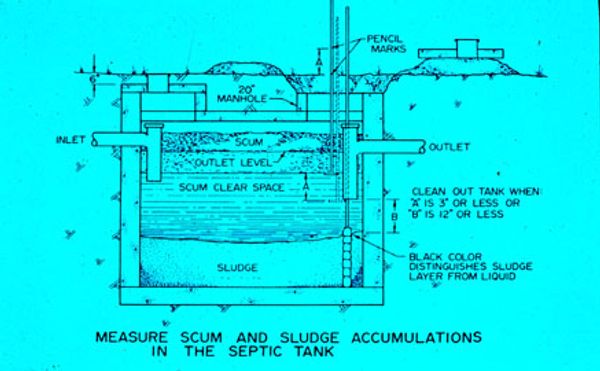
A main question when you're buying a home is whether the septic system needs to be pumped. Pump outs can cost anywhere from $300-500 in most cases, or more if additional work is required. During our inspection, we can help determine if it's time for the system to be pumped. In general, it's time to get it pumped if any of the following are true:
- Combined sludge and scum is greater than 25-30% of the working volume
- Top of the sludge layer is less than 12 inches from the bottom of the outlet baffle
- Scum layer is at, near, or above the top of the inlet baffle
- Bottom of scum layer is less than 3" from bottom of outlet baffle
- Effluent layer is less than 2-3” from the bottom of the inlet baffle’s (horizontally-run) opening
- Trash, debris, sanitary wipes, (any toilet paper is ok), any other foreign objects like shrubs, gravel, rocks, dirt, etc.
- It's been more than 3-5 years since the last pump out or the time since the last pump out is unknown.


Only hire a NAWT licensed septic inspector. NAWT licensing ensure your inspector has been properly trained in how to perform a septic system inspection. To maintain this license, we must meet continuing education requirements every two years. This ensures we are up to date on the latest septic technologies and information.